Ivory and blush fabric palette
Folded ivory, blush and lavender fabrics arranged as a soft neutral colour reference.
For your sourcing brief: Fibre composition, knit or weave, GSM, usable width and approved shades.
Composition CottonWeight Knit 120-380 gsm
Full specificationstyling · fabrication · composition · weight · sustainability · performance
- Styling & fit
- Fabric palette and range: solid, heather, stripe or printed; colour-matched to Pantone TCX/TPX or swatch.
- Fabrication
- Knit or woven; ring-spun, combed or compact yarn; reactive, pigment, disperse or vat dyed; softener, peach, brushed or mercerised finishes.
- Composition
- Cotton; polyester; viscose; modal; Tencel; linen; elastane; and blends such as 60/40 cotton-polyester, 95/5 cotton-elastane.
- Weight
- Knit 120-380 gsm; woven 80-420 gsm; width 150-180 cm (cuttable).
- Construction & stitching
- Single jersey, rib, interlock, French terry, fleece, piqué; poplin, twill, oxford, denim; jacquard and dobby on request.
- Trims, branding & finish
- Lab dips and strike-offs before bulk; roll packing; fabric hand-feel, hang-test and shade-band approvals.
- Sustainability
- Options: organic (GOTS), BCI, GRS recycled, Tencel, ZDHC-aligned and OEKO-TEX-tested dyehouses, closed-loop water treatment.
- Performance
- Shrinkage, colourfastness, pilling and tensile strength to ISO or AATCC; wicking, anti-bacterial, UPF, flame-retardant or water-repellent finishes.
- Sizing, packing & MOQ
- Minimum order from 500-1,000 m per colour, 40-70 days after lab-dip approval; sample yardage on request.
- Compliance & testing
- Typical: composition and GSM, shrinkage, colourfastness (wash, rub, light, perspiration), pH, formaldehyde, azo dyes; OEKO-TEX or RSL on request.
Indicative ranges for discussion. Final composition, GSM, measurements, MOQ and tests are agreed at sampling and quotation.
Soft pastel fabric stack
A stack of pale pink, cream, light beige and lavender fabric lengths.
For your sourcing brief: Composition, construction, GSM and colour standards.
Composition CottonWeight Knit 120-380 gsm
Full specificationstyling · fabrication · composition · weight · sustainability · performance
- Styling & fit
- Fabric palette and range: solid, heather, stripe or printed; colour-matched to Pantone TCX/TPX or swatch.
- Fabrication
- Knit or woven; ring-spun, combed or compact yarn; reactive, pigment, disperse or vat dyed; softener, peach, brushed or mercerised finishes.
- Composition
- Cotton; polyester; viscose; modal; Tencel; linen; elastane; and blends such as 60/40 cotton-polyester, 95/5 cotton-elastane.
- Weight
- Knit 120-380 gsm; woven 80-420 gsm; width 150-180 cm (cuttable).
- Construction & stitching
- Single jersey, rib, interlock, French terry, fleece, piqué; poplin, twill, oxford, denim; jacquard and dobby on request.
- Trims, branding & finish
- Lab dips and strike-offs before bulk; roll packing; fabric hand-feel, hang-test and shade-band approvals.
- Sustainability
- Options: organic (GOTS), BCI, GRS recycled, Tencel, ZDHC-aligned and OEKO-TEX-tested dyehouses, closed-loop water treatment.
- Performance
- Shrinkage, colourfastness, pilling and tensile strength to ISO or AATCC; wicking, anti-bacterial, UPF, flame-retardant or water-repellent finishes.
- Sizing, packing & MOQ
- Minimum order from 500-1,000 m per colour, 40-70 days after lab-dip approval; sample yardage on request.
- Compliance & testing
- Typical: composition and GSM, shrinkage, colourfastness (wash, rub, light, perspiration), pH, formaldehyde, azo dyes; OEKO-TEX or RSL on request.
Indicative ranges for discussion. Final composition, GSM, measurements, MOQ and tests are agreed at sampling and quotation.
Pastel drape and fold reference
Cream, blush and lavender fabrics shown folded with softly falling edges.
For your sourcing brief: Fabric construction, finish, GSM and required drape.
Composition CottonWeight Knit 120-380 gsm
Full specificationstyling · fabrication · composition · weight · sustainability · performance
- Styling & fit
- Fabric palette and range: solid, heather, stripe or printed; colour-matched to Pantone TCX/TPX or swatch.
- Fabrication
- Knit or woven; ring-spun, combed or compact yarn; reactive, pigment, disperse or vat dyed; softener, peach, brushed or mercerised finishes.
- Composition
- Cotton; polyester; viscose; modal; Tencel; linen; elastane; and blends such as 60/40 cotton-polyester, 95/5 cotton-elastane.
- Weight
- Knit 120-380 gsm; woven 80-420 gsm; width 150-180 cm (cuttable).
- Construction & stitching
- Single jersey, rib, interlock, French terry, fleece, piqué; poplin, twill, oxford, denim; jacquard and dobby on request.
- Trims, branding & finish
- Lab dips and strike-offs before bulk; roll packing; fabric hand-feel, hang-test and shade-band approvals.
- Sustainability
- Options: organic (GOTS), BCI, GRS recycled, Tencel, ZDHC-aligned and OEKO-TEX-tested dyehouses, closed-loop water treatment.
- Performance
- Shrinkage, colourfastness, pilling and tensile strength to ISO or AATCC; wicking, anti-bacterial, UPF, flame-retardant or water-repellent finishes.
- Sizing, packing & MOQ
- Minimum order from 500-1,000 m per colour, 40-70 days after lab-dip approval; sample yardage on request.
- Compliance & testing
- Typical: composition and GSM, shrinkage, colourfastness (wash, rub, light, perspiration), pH, formaldehyde, azo dyes; OEKO-TEX or RSL on request.
Indicative ranges for discussion. Final composition, GSM, measurements, MOQ and tests are agreed at sampling and quotation.
Neutral and lilac fabric selection
Layered folded fabrics in ivory, cream, lilac and light pink tones.
For your sourcing brief: Composition, construction, weight, width and colour approvals.
Composition CottonWeight Knit 120-380 gsm
Full specificationstyling · fabrication · composition · weight · sustainability · performance
- Styling & fit
- Fabric palette and range: solid, heather, stripe or printed; colour-matched to Pantone TCX/TPX or swatch.
- Fabrication
- Knit or woven; ring-spun, combed or compact yarn; reactive, pigment, disperse or vat dyed; softener, peach, brushed or mercerised finishes.
- Composition
- Cotton; polyester; viscose; modal; Tencel; linen; elastane; and blends such as 60/40 cotton-polyester, 95/5 cotton-elastane.
- Weight
- Knit 120-380 gsm; woven 80-420 gsm; width 150-180 cm (cuttable).
- Construction & stitching
- Single jersey, rib, interlock, French terry, fleece, piqué; poplin, twill, oxford, denim; jacquard and dobby on request.
- Trims, branding & finish
- Lab dips and strike-offs before bulk; roll packing; fabric hand-feel, hang-test and shade-band approvals.
- Sustainability
- Options: organic (GOTS), BCI, GRS recycled, Tencel, ZDHC-aligned and OEKO-TEX-tested dyehouses, closed-loop water treatment.
- Performance
- Shrinkage, colourfastness, pilling and tensile strength to ISO or AATCC; wicking, anti-bacterial, UPF, flame-retardant or water-repellent finishes.
- Sizing, packing & MOQ
- Minimum order from 500-1,000 m per colour, 40-70 days after lab-dip approval; sample yardage on request.
- Compliance & testing
- Typical: composition and GSM, shrinkage, colourfastness (wash, rub, light, perspiration), pH, formaldehyde, azo dyes; OEKO-TEX or RSL on request.
Indicative ranges for discussion. Final composition, GSM, measurements, MOQ and tests are agreed at sampling and quotation.
Single-jersey fabric concept
The reference image is labelled Single Jersey Fabrics and shows folded pastel shades.
For your sourcing brief: Confirm jersey construction, composition, GSM, shrinkage and colour fastness.
Composition CottonWeight 120-220 gsm
Full specificationstyling · fabrication · composition · weight · sustainability · performance
- Styling & fit
- Single jersey: smooth face, soft hand, light drape; for tees, tanks, dresses and base layers.
- Fabrication
- Circular knit, 24-30G; combed ring-spun 30s-40s Ne; compact, slub or melange; bio-polished.
- Composition
- Cotton; polyester; viscose; modal; Tencel; linen; elastane; and blends such as 60/40 cotton-polyester, 95/5 cotton-elastane.
- Weight
- 120-220 gsm; 140-180 gsm typical.
- Construction & stitching
- Plain knit stitch, 1x1 loop structure, tubular roll or open-width; width 160-185 cm.
- Trims, branding & finish
- Lab dips and strike-offs before bulk; roll packing; fabric hand-feel, hang-test and shade-band approvals.
- Sustainability
- Options: organic (GOTS), BCI, GRS recycled, Tencel, ZDHC-aligned and OEKO-TEX-tested dyehouses, closed-loop water treatment.
- Performance
- Shrinkage, colourfastness, pilling and tensile strength to ISO or AATCC; wicking, anti-bacterial, UPF, flame-retardant or water-repellent finishes.
- Sizing, packing & MOQ
- Minimum order from 500-1,000 m per colour, 40-70 days after lab-dip approval; sample yardage on request.
- Compliance & testing
- Typical: composition and GSM, shrinkage, colourfastness (wash, rub, light, perspiration), pH, formaldehyde, azo dyes; OEKO-TEX or RSL on request.
Indicative ranges for discussion. Final composition, GSM, measurements, MOQ and tests are agreed at sampling and quotation.
Bright solid-colour fabric palette
A fan arrangement of red, orange, yellow, green, blue and pink fabric shades.
For your sourcing brief: Composition, construction, GSM, dye standards and shade matching.
Composition CottonWeight Knit 120-380 gsm
Full specificationstyling · fabrication · composition · weight · sustainability · performance
- Styling & fit
- Fabric palette and range: solid, heather, stripe or printed; colour-matched to Pantone TCX/TPX or swatch.
- Fabrication
- Knit or woven; ring-spun, combed or compact yarn; reactive, pigment, disperse or vat dyed; softener, peach, brushed or mercerised finishes.
- Composition
- Cotton; polyester; viscose; modal; Tencel; linen; elastane; and blends such as 60/40 cotton-polyester, 95/5 cotton-elastane.
- Weight
- Knit 120-380 gsm; woven 80-420 gsm; width 150-180 cm (cuttable).
- Construction & stitching
- Single jersey, rib, interlock, French terry, fleece, piqué; poplin, twill, oxford, denim; jacquard and dobby on request.
- Trims, branding & finish
- Lab dips and strike-offs before bulk; roll packing; fabric hand-feel, hang-test and shade-band approvals.
- Sustainability
- Options: organic (GOTS), BCI, GRS recycled, Tencel, ZDHC-aligned and OEKO-TEX-tested dyehouses, closed-loop water treatment.
- Performance
- Shrinkage, colourfastness, pilling and tensile strength to ISO or AATCC; wicking, anti-bacterial, UPF, flame-retardant or water-repellent finishes.
- Sizing, packing & MOQ
- Minimum order from 500-1,000 m per colour, 40-70 days after lab-dip approval; sample yardage on request.
- Compliance & testing
- Typical: composition and GSM, shrinkage, colourfastness (wash, rub, light, perspiration), pH, formaldehyde, azo dyes; OEKO-TEX or RSL on request.
Indicative ranges for discussion. Final composition, GSM, measurements, MOQ and tests are agreed at sampling and quotation.
Solid and patterned fabric coordination
Blush and cream solids are paired with blue patterned fabrics in a fan arrangement.
For your sourcing brief: Base fabric, print artwork, colour palette and finished weight.
Composition CottonWeight Knit 120-380 gsm
Full specificationstyling · fabrication · composition · weight · sustainability · performance
- Styling & fit
- Fabric palette and range: solid, heather, stripe or printed; colour-matched to Pantone TCX/TPX or swatch.
- Fabrication
- Knit or woven; ring-spun, combed or compact yarn; reactive, pigment, disperse or vat dyed; softener, peach, brushed or mercerised finishes.
- Composition
- Cotton; polyester; viscose; modal; Tencel; linen; elastane; and blends such as 60/40 cotton-polyester, 95/5 cotton-elastane.
- Weight
- Knit 120-380 gsm; woven 80-420 gsm; width 150-180 cm (cuttable).
- Construction & stitching
- Single jersey, rib, interlock, French terry, fleece, piqué; poplin, twill, oxford, denim; jacquard and dobby on request.
- Trims, branding & finish
- Lab dips and strike-offs before bulk; roll packing; fabric hand-feel, hang-test and shade-band approvals.
- Sustainability
- Options: organic (GOTS), BCI, GRS recycled, Tencel, ZDHC-aligned and OEKO-TEX-tested dyehouses, closed-loop water treatment.
- Performance
- Shrinkage, colourfastness, pilling and tensile strength to ISO or AATCC; wicking, anti-bacterial, UPF, flame-retardant or water-repellent finishes.
- Sizing, packing & MOQ
- Minimum order from 500-1,000 m per colour, 40-70 days after lab-dip approval; sample yardage on request.
- Compliance & testing
- Typical: composition and GSM, shrinkage, colourfastness (wash, rub, light, perspiration), pH, formaldehyde, azo dyes; OEKO-TEX or RSL on request.
Indicative ranges for discussion. Final composition, GSM, measurements, MOQ and tests are agreed at sampling and quotation.
Mixed solid and print palette
Bright solid fabrics are arranged with patterned fabric sections as a collection colour reference.
For your sourcing brief: Construction, print method, artwork and approved colour standards.
Composition CottonWeight Knit 120-380 gsm
Full specificationstyling · fabrication · composition · weight · sustainability · performance
- Styling & fit
- Fabric palette and range: solid, heather, stripe or printed; colour-matched to Pantone TCX/TPX or swatch.
- Fabrication
- Knit or woven; ring-spun, combed or compact yarn; reactive, pigment, disperse or vat dyed; softener, peach, brushed or mercerised finishes.
- Composition
- Cotton; polyester; viscose; modal; Tencel; linen; elastane; and blends such as 60/40 cotton-polyester, 95/5 cotton-elastane.
- Weight
- Knit 120-380 gsm; woven 80-420 gsm; width 150-180 cm (cuttable).
- Construction & stitching
- Single jersey, rib, interlock, French terry, fleece, piqué; poplin, twill, oxford, denim; jacquard and dobby on request.
- Trims, branding & finish
- Lab dips and strike-offs before bulk; roll packing; fabric hand-feel, hang-test and shade-band approvals.
- Sustainability
- Options: organic (GOTS), BCI, GRS recycled, Tencel, ZDHC-aligned and OEKO-TEX-tested dyehouses, closed-loop water treatment.
- Performance
- Shrinkage, colourfastness, pilling and tensile strength to ISO or AATCC; wicking, anti-bacterial, UPF, flame-retardant or water-repellent finishes.
- Sizing, packing & MOQ
- Minimum order from 500-1,000 m per colour, 40-70 days after lab-dip approval; sample yardage on request.
- Compliance & testing
- Typical: composition and GSM, shrinkage, colourfastness (wash, rub, light, perspiration), pH, formaldehyde, azo dyes; OEKO-TEX or RSL on request.
Indicative ranges for discussion. Final composition, GSM, measurements, MOQ and tests are agreed at sampling and quotation.
Ivory drape reference
A light ivory fabric is gathered into soft folds to illustrate the visual fall of the material.
For your sourcing brief: Composition, construction, finish, opacity and required drape.
Composition CottonWeight Knit 120-380 gsm
Full specificationstyling · fabrication · composition · weight · sustainability · performance
- Styling & fit
- Fabric palette and range: solid, heather, stripe or printed; colour-matched to Pantone TCX/TPX or swatch.
- Fabrication
- Knit or woven; ring-spun, combed or compact yarn; reactive, pigment, disperse or vat dyed; softener, peach, brushed or mercerised finishes.
- Composition
- Cotton; polyester; viscose; modal; Tencel; linen; elastane; and blends such as 60/40 cotton-polyester, 95/5 cotton-elastane.
- Weight
- Knit 120-380 gsm; woven 80-420 gsm; width 150-180 cm (cuttable).
- Construction & stitching
- Single jersey, rib, interlock, French terry, fleece, piqué; poplin, twill, oxford, denim; jacquard and dobby on request.
- Trims, branding & finish
- Lab dips and strike-offs before bulk; roll packing; fabric hand-feel, hang-test and shade-band approvals.
- Sustainability
- Options: organic (GOTS), BCI, GRS recycled, Tencel, ZDHC-aligned and OEKO-TEX-tested dyehouses, closed-loop water treatment.
- Performance
- Shrinkage, colourfastness, pilling and tensile strength to ISO or AATCC; wicking, anti-bacterial, UPF, flame-retardant or water-repellent finishes.
- Sizing, packing & MOQ
- Minimum order from 500-1,000 m per colour, 40-70 days after lab-dip approval; sample yardage on request.
- Compliance & testing
- Typical: composition and GSM, shrinkage, colourfastness (wash, rub, light, perspiration), pH, formaldehyde, azo dyes; OEKO-TEX or RSL on request.
Indicative ranges for discussion. Final composition, GSM, measurements, MOQ and tests are agreed at sampling and quotation.
Floral print collection
Several floral patterns on light and dark grounds are presented as print-design references.
For your sourcing brief: Base fabric, repeat size, artwork ownership and print colour approvals.
Composition CottonWeight Knit 120-380 gsm
Full specificationstyling · fabrication · composition · weight · sustainability · performance
- Styling & fit
- Printed fabric: floral, geometric, stripe or conversational prints; placement or all-over; engineered prints on request.
- Fabrication
- Rotary, digital or screen print on cotton, viscose, polyester or blends; pigment or reactive inks; wash-down and hand-feel finishes.
- Composition
- Cotton; polyester; viscose; modal; Tencel; linen; elastane; and blends such as 60/40 cotton-polyester, 95/5 cotton-elastane.
- Weight
- Knit 120-380 gsm; woven 80-420 gsm; width 150-180 cm (cuttable).
- Construction & stitching
- Single jersey, rib, interlock, French terry, fleece, piqué; poplin, twill, oxford, denim; jacquard and dobby on request.
- Trims, branding & finish
- Strike-offs and colour approvals, repeat sizes, placement artwork, roll-end and defect marking.
- Sustainability
- Options: organic (GOTS), BCI, GRS recycled, Tencel, ZDHC-aligned and OEKO-TEX-tested dyehouses, closed-loop water treatment.
- Performance
- Shrinkage, colourfastness, pilling and tensile strength to ISO or AATCC; wicking, anti-bacterial, UPF, flame-retardant or water-repellent finishes.
- Sizing, packing & MOQ
- Minimum order from 500-1,000 m per colour, 40-70 days after lab-dip approval; sample yardage on request.
- Compliance & testing
- Typical: composition and GSM, shrinkage, colourfastness (wash, rub, light, perspiration), pH, formaldehyde, azo dyes; OEKO-TEX or RSL on request.
Indicative ranges for discussion. Final composition, GSM, measurements, MOQ and tests are agreed at sampling and quotation.
Pastel fabric styling display
Mint, pink and lavender fabric lengths are draped alongside folded pieces.
For your sourcing brief: Fabric specification, colours, finish and sampling quantities.
Composition CottonWeight Knit 120-380 gsm
Full specificationstyling · fabrication · composition · weight · sustainability · performance
- Styling & fit
- Fabric palette and range: solid, heather, stripe or printed; colour-matched to Pantone TCX/TPX or swatch.
- Fabrication
- Knit or woven; ring-spun, combed or compact yarn; reactive, pigment, disperse or vat dyed; softener, peach, brushed or mercerised finishes.
- Composition
- Cotton; polyester; viscose; modal; Tencel; linen; elastane; and blends such as 60/40 cotton-polyester, 95/5 cotton-elastane.
- Weight
- Knit 120-380 gsm; woven 80-420 gsm; width 150-180 cm (cuttable).
- Construction & stitching
- Single jersey, rib, interlock, French terry, fleece, piqué; poplin, twill, oxford, denim; jacquard and dobby on request.
- Trims, branding & finish
- Lab dips and strike-offs before bulk; roll packing; fabric hand-feel, hang-test and shade-band approvals.
- Sustainability
- Options: organic (GOTS), BCI, GRS recycled, Tencel, ZDHC-aligned and OEKO-TEX-tested dyehouses, closed-loop water treatment.
- Performance
- Shrinkage, colourfastness, pilling and tensile strength to ISO or AATCC; wicking, anti-bacterial, UPF, flame-retardant or water-repellent finishes.
- Sizing, packing & MOQ
- Minimum order from 500-1,000 m per colour, 40-70 days after lab-dip approval; sample yardage on request.
- Compliance & testing
- Typical: composition and GSM, shrinkage, colourfastness (wash, rub, light, perspiration), pH, formaldehyde, azo dyes; OEKO-TEX or RSL on request.
Indicative ranges for discussion. Final composition, GSM, measurements, MOQ and tests are agreed at sampling and quotation.
Light neutral fabric sourcing reference
Folded pale fabrics sit in front of shelves of fabric rolls in a showroom-style image.
For your sourcing brief: Select the required construction, composition, weight and width.
Composition CottonWeight Knit 120-380 gsm
Full specificationstyling · fabrication · composition · weight · sustainability · performance
- Styling & fit
- Fabric palette and range: solid, heather, stripe or printed; colour-matched to Pantone TCX/TPX or swatch.
- Fabrication
- Knit or woven; ring-spun, combed or compact yarn; reactive, pigment, disperse or vat dyed; softener, peach, brushed or mercerised finishes.
- Composition
- Cotton; polyester; viscose; modal; Tencel; linen; elastane; and blends such as 60/40 cotton-polyester, 95/5 cotton-elastane.
- Weight
- Knit 120-380 gsm; woven 80-420 gsm; width 150-180 cm (cuttable).
- Construction & stitching
- Single jersey, rib, interlock, French terry, fleece, piqué; poplin, twill, oxford, denim; jacquard and dobby on request.
- Trims, branding & finish
- Lab dips and strike-offs before bulk; roll packing; fabric hand-feel, hang-test and shade-band approvals.
- Sustainability
- Options: organic (GOTS), BCI, GRS recycled, Tencel, ZDHC-aligned and OEKO-TEX-tested dyehouses, closed-loop water treatment.
- Performance
- Shrinkage, colourfastness, pilling and tensile strength to ISO or AATCC; wicking, anti-bacterial, UPF, flame-retardant or water-repellent finishes.
- Sizing, packing & MOQ
- Minimum order from 500-1,000 m per colour, 40-70 days after lab-dip approval; sample yardage on request.
- Compliance & testing
- Typical: composition and GSM, shrinkage, colourfastness (wash, rub, light, perspiration), pH, formaldehyde, azo dyes; OEKO-TEX or RSL on request.
Indicative ranges for discussion. Final composition, GSM, measurements, MOQ and tests are agreed at sampling and quotation.
Bold solid fabric colour range
Stacked fabric edges show orange, white, grey, yellow, red and blue shades.
For your sourcing brief: Base fabric, GSM, usable width and lab-dip approvals.
Composition CottonWeight Knit 120-380 gsm
Full specificationstyling · fabrication · composition · weight · sustainability · performance
- Styling & fit
- Fabric palette and range: solid, heather, stripe or printed; colour-matched to Pantone TCX/TPX or swatch.
- Fabrication
- Knit or woven; ring-spun, combed or compact yarn; reactive, pigment, disperse or vat dyed; softener, peach, brushed or mercerised finishes.
- Composition
- Cotton; polyester; viscose; modal; Tencel; linen; elastane; and blends such as 60/40 cotton-polyester, 95/5 cotton-elastane.
- Weight
- Knit 120-380 gsm; woven 80-420 gsm; width 150-180 cm (cuttable).
- Construction & stitching
- Single jersey, rib, interlock, French terry, fleece, piqué; poplin, twill, oxford, denim; jacquard and dobby on request.
- Trims, branding & finish
- Lab dips and strike-offs before bulk; roll packing; fabric hand-feel, hang-test and shade-band approvals.
- Sustainability
- Options: organic (GOTS), BCI, GRS recycled, Tencel, ZDHC-aligned and OEKO-TEX-tested dyehouses, closed-loop water treatment.
- Performance
- Shrinkage, colourfastness, pilling and tensile strength to ISO or AATCC; wicking, anti-bacterial, UPF, flame-retardant or water-repellent finishes.
- Sizing, packing & MOQ
- Minimum order from 500-1,000 m per colour, 40-70 days after lab-dip approval; sample yardage on request.
- Compliance & testing
- Typical: composition and GSM, shrinkage, colourfastness (wash, rub, light, perspiration), pH, formaldehyde, azo dyes; OEKO-TEX or RSL on request.
Indicative ranges for discussion. Final composition, GSM, measurements, MOQ and tests are agreed at sampling and quotation.
Fabric assortment display
Shelving holds stacks of coloured fabric lengths in a bright display setting.
For your sourcing brief: Identify the required material, construction, shade and order volume.
Composition CottonWeight Knit 120-380 gsm
Full specificationstyling · fabrication · composition · weight · sustainability · performance
- Styling & fit
- Fabric palette and range: solid, heather, stripe or printed; colour-matched to Pantone TCX/TPX or swatch.
- Fabrication
- Knit or woven; ring-spun, combed or compact yarn; reactive, pigment, disperse or vat dyed; softener, peach, brushed or mercerised finishes.
- Composition
- Cotton; polyester; viscose; modal; Tencel; linen; elastane; and blends such as 60/40 cotton-polyester, 95/5 cotton-elastane.
- Weight
- Knit 120-380 gsm; woven 80-420 gsm; width 150-180 cm (cuttable).
- Construction & stitching
- Single jersey, rib, interlock, French terry, fleece, piqué; poplin, twill, oxford, denim; jacquard and dobby on request.
- Trims, branding & finish
- Lab dips and strike-offs before bulk; roll packing; fabric hand-feel, hang-test and shade-band approvals.
- Sustainability
- Options: organic (GOTS), BCI, GRS recycled, Tencel, ZDHC-aligned and OEKO-TEX-tested dyehouses, closed-loop water treatment.
- Performance
- Shrinkage, colourfastness, pilling and tensile strength to ISO or AATCC; wicking, anti-bacterial, UPF, flame-retardant or water-repellent finishes.
- Sizing, packing & MOQ
- Minimum order from 500-1,000 m per colour, 40-70 days after lab-dip approval; sample yardage on request.
- Compliance & testing
- Typical: composition and GSM, shrinkage, colourfastness (wash, rub, light, perspiration), pH, formaldehyde, azo dyes; OEKO-TEX or RSL on request.
Indicative ranges for discussion. Final composition, GSM, measurements, MOQ and tests are agreed at sampling and quotation.
Extended solid shade palette
Layers of brightly coloured, neutral and pastel fabric edges form a broad colour range.
For your sourcing brief: Composition, construction, GSM and approved colour references.
Composition CottonWeight Knit 120-380 gsm
Full specificationstyling · fabrication · composition · weight · sustainability · performance
- Styling & fit
- Fabric palette and range: solid, heather, stripe or printed; colour-matched to Pantone TCX/TPX or swatch.
- Fabrication
- Knit or woven; ring-spun, combed or compact yarn; reactive, pigment, disperse or vat dyed; softener, peach, brushed or mercerised finishes.
- Composition
- Cotton; polyester; viscose; modal; Tencel; linen; elastane; and blends such as 60/40 cotton-polyester, 95/5 cotton-elastane.
- Weight
- Knit 120-380 gsm; woven 80-420 gsm; width 150-180 cm (cuttable).
- Construction & stitching
- Single jersey, rib, interlock, French terry, fleece, piqué; poplin, twill, oxford, denim; jacquard and dobby on request.
- Trims, branding & finish
- Lab dips and strike-offs before bulk; roll packing; fabric hand-feel, hang-test and shade-band approvals.
- Sustainability
- Options: organic (GOTS), BCI, GRS recycled, Tencel, ZDHC-aligned and OEKO-TEX-tested dyehouses, closed-loop water treatment.
- Performance
- Shrinkage, colourfastness, pilling and tensile strength to ISO or AATCC; wicking, anti-bacterial, UPF, flame-retardant or water-repellent finishes.
- Sizing, packing & MOQ
- Minimum order from 500-1,000 m per colour, 40-70 days after lab-dip approval; sample yardage on request.
- Compliance & testing
- Typical: composition and GSM, shrinkage, colourfastness (wash, rub, light, perspiration), pH, formaldehyde, azo dyes; OEKO-TEX or RSL on request.
Indicative ranges for discussion. Final composition, GSM, measurements, MOQ and tests are agreed at sampling and quotation.
Solid and printed fabric roll range
Shelves display rolls in solid shades and multicoloured printed designs.
For your sourcing brief: Fabric specification, print repeat, roll width and inspection requirements.
Composition CottonWeight Knit 120-380 gsm
Full specificationstyling · fabrication · composition · weight · sustainability · performance
- Styling & fit
- Printed fabric: floral, geometric, stripe or conversational prints; placement or all-over; engineered prints on request.
- Fabrication
- Rotary, digital or screen print on cotton, viscose, polyester or blends; pigment or reactive inks; wash-down and hand-feel finishes.
- Composition
- Cotton; polyester; viscose; modal; Tencel; linen; elastane; and blends such as 60/40 cotton-polyester, 95/5 cotton-elastane.
- Weight
- Knit 120-380 gsm; woven 80-420 gsm; width 150-180 cm (cuttable).
- Construction & stitching
- Single jersey, rib, interlock, French terry, fleece, piqué; poplin, twill, oxford, denim; jacquard and dobby on request.
- Trims, branding & finish
- Strike-offs and colour approvals, repeat sizes, placement artwork, roll-end and defect marking.
- Sustainability
- Options: organic (GOTS), BCI, GRS recycled, Tencel, ZDHC-aligned and OEKO-TEX-tested dyehouses, closed-loop water treatment.
- Performance
- Shrinkage, colourfastness, pilling and tensile strength to ISO or AATCC; wicking, anti-bacterial, UPF, flame-retardant or water-repellent finishes.
- Sizing, packing & MOQ
- Minimum order from 500-1,000 m per colour, 40-70 days after lab-dip approval; sample yardage on request.
- Compliance & testing
- Typical: composition and GSM, shrinkage, colourfastness (wash, rub, light, perspiration), pH, formaldehyde, azo dyes; OEKO-TEX or RSL on request.
Indicative ranges for discussion. Final composition, GSM, measurements, MOQ and tests are agreed at sampling and quotation.
Solid-colour fabric rolls
A close view of upright rolls shows black, red, blue, green and cream colours.
For your sourcing brief: Composition, knit or weave, GSM, width and shade tolerance.
Composition CottonWeight Knit 120-380 gsm
Full specificationstyling · fabrication · composition · weight · sustainability · performance
- Styling & fit
- Fabric palette and range: solid, heather, stripe or printed; colour-matched to Pantone TCX/TPX or swatch.
- Fabrication
- Knit or woven; ring-spun, combed or compact yarn; reactive, pigment, disperse or vat dyed; softener, peach, brushed or mercerised finishes.
- Composition
- Cotton; polyester; viscose; modal; Tencel; linen; elastane; and blends such as 60/40 cotton-polyester, 95/5 cotton-elastane.
- Weight
- Knit 120-380 gsm; woven 80-420 gsm; width 150-180 cm (cuttable).
- Construction & stitching
- Single jersey, rib, interlock, French terry, fleece, piqué; poplin, twill, oxford, denim; jacquard and dobby on request.
- Trims, branding & finish
- Lab dips and strike-offs before bulk; roll packing; fabric hand-feel, hang-test and shade-band approvals.
- Sustainability
- Options: organic (GOTS), BCI, GRS recycled, Tencel, ZDHC-aligned and OEKO-TEX-tested dyehouses, closed-loop water treatment.
- Performance
- Shrinkage, colourfastness, pilling and tensile strength to ISO or AATCC; wicking, anti-bacterial, UPF, flame-retardant or water-repellent finishes.
- Sizing, packing & MOQ
- Minimum order from 500-1,000 m per colour, 40-70 days after lab-dip approval; sample yardage on request.
- Compliance & testing
- Typical: composition and GSM, shrinkage, colourfastness (wash, rub, light, perspiration), pH, formaldehyde, azo dyes; OEKO-TEX or RSL on request.
Indicative ranges for discussion. Final composition, GSM, measurements, MOQ and tests are agreed at sampling and quotation.
Blue and mint fabric roll palette
Rows of fabric rolls display blue, turquoise and mint tones.
For your sourcing brief: Base construction, fibre blend, weight, usable width and colour approvals.
Composition CottonWeight Knit 120-380 gsm
Full specificationstyling · fabrication · composition · weight · sustainability · performance
- Styling & fit
- Fabric palette and range: solid, heather, stripe or printed; colour-matched to Pantone TCX/TPX or swatch.
- Fabrication
- Knit or woven; ring-spun, combed or compact yarn; reactive, pigment, disperse or vat dyed; softener, peach, brushed or mercerised finishes.
- Composition
- Cotton; polyester; viscose; modal; Tencel; linen; elastane; and blends such as 60/40 cotton-polyester, 95/5 cotton-elastane.
- Weight
- Knit 120-380 gsm; woven 80-420 gsm; width 150-180 cm (cuttable).
- Construction & stitching
- Single jersey, rib, interlock, French terry, fleece, piqué; poplin, twill, oxford, denim; jacquard and dobby on request.
- Trims, branding & finish
- Lab dips and strike-offs before bulk; roll packing; fabric hand-feel, hang-test and shade-band approvals.
- Sustainability
- Options: organic (GOTS), BCI, GRS recycled, Tencel, ZDHC-aligned and OEKO-TEX-tested dyehouses, closed-loop water treatment.
- Performance
- Shrinkage, colourfastness, pilling and tensile strength to ISO or AATCC; wicking, anti-bacterial, UPF, flame-retardant or water-repellent finishes.
- Sizing, packing & MOQ
- Minimum order from 500-1,000 m per colour, 40-70 days after lab-dip approval; sample yardage on request.
- Compliance & testing
- Typical: composition and GSM, shrinkage, colourfastness (wash, rub, light, perspiration), pH, formaldehyde, azo dyes; OEKO-TEX or RSL on request.
Indicative ranges for discussion. Final composition, GSM, measurements, MOQ and tests are agreed at sampling and quotation.
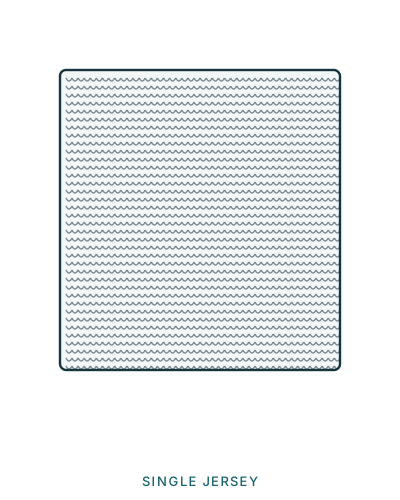
Single jersey structure
Smooth single-jersey loop structure.
For your sourcing brief: Yarn count, GSM, finish and width.
Composition CottonWeight 120-220 gsm
Full specificationstyling · fabrication · composition · weight · sustainability · performance
- Styling & fit
- Single jersey: smooth face, soft hand, light drape; for tees, tanks, dresses and base layers.
- Fabrication
- Circular knit, 24-30G; combed ring-spun 30s-40s Ne; compact, slub or melange; bio-polished.
- Composition
- Cotton; polyester; viscose; modal; Tencel; linen; elastane; and blends such as 60/40 cotton-polyester, 95/5 cotton-elastane.
- Weight
- 120-220 gsm; 140-180 gsm typical.
- Construction & stitching
- Plain knit stitch, 1x1 loop structure, tubular roll or open-width; width 160-185 cm.
- Trims, branding & finish
- Lab dips and strike-offs before bulk; roll packing; fabric hand-feel, hang-test and shade-band approvals.
- Sustainability
- Options: organic (GOTS), BCI, GRS recycled, Tencel, ZDHC-aligned and OEKO-TEX-tested dyehouses, closed-loop water treatment.
- Performance
- Shrinkage, colourfastness, pilling and tensile strength to ISO or AATCC; wicking, anti-bacterial, UPF, flame-retardant or water-repellent finishes.
- Sizing, packing & MOQ
- Minimum order from 500-1,000 m per colour, 40-70 days after lab-dip approval; sample yardage on request.
- Compliance & testing
- Typical: composition and GSM, shrinkage, colourfastness (wash, rub, light, perspiration), pH, formaldehyde, azo dyes; OEKO-TEX or RSL on request.
Indicative ranges for discussion. Final composition, GSM, measurements, MOQ and tests are agreed at sampling and quotation.
1x1 rib structure
Vertical rib with stretch and recovery.
For your sourcing brief: Rib type, elastane, GSM and width.
Composition CottonWeight 180-320 gsm
Full specificationstyling · fabrication · composition · weight · sustainability · performance
- Styling & fit
- 1x1 or 2x2 rib: stretchy, vertical ridges; for neckbands, cuffs, hems and fitted tops.
- Fabrication
- Rib circular knit with elastane; combed cotton, modal or viscose blends.
- Composition
- Cotton; polyester; viscose; modal; Tencel; linen; elastane; and blends such as 60/40 cotton-polyester, 95/5 cotton-elastane.
- Weight
- 180-320 gsm; 200-260 gsm typical.
- Construction & stitching
- Alternating wales on face and back, high recovery, tubular or open width.
- Trims, branding & finish
- Lab dips and strike-offs before bulk; roll packing; fabric hand-feel, hang-test and shade-band approvals.
- Sustainability
- Options: organic (GOTS), BCI, GRS recycled, Tencel, ZDHC-aligned and OEKO-TEX-tested dyehouses, closed-loop water treatment.
- Performance
- Shrinkage, colourfastness, pilling and tensile strength to ISO or AATCC; wicking, anti-bacterial, UPF, flame-retardant or water-repellent finishes.
- Sizing, packing & MOQ
- Minimum order from 500-1,000 m per colour, 40-70 days after lab-dip approval; sample yardage on request.
- Compliance & testing
- Typical: composition and GSM, shrinkage, colourfastness (wash, rub, light, perspiration), pH, formaldehyde, azo dyes; OEKO-TEX or RSL on request.
Indicative ranges for discussion. Final composition, GSM, measurements, MOQ and tests are agreed at sampling and quotation.
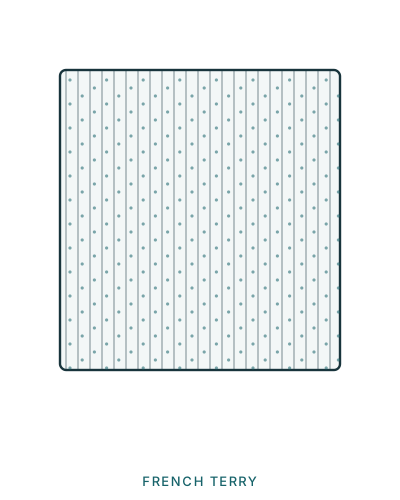
French terry structure
Smooth face with looped back.
For your sourcing brief: Yarn, GSM, brushing and width.
Composition CottonWeight 220-380 gsm
Full specificationstyling · fabrication · composition · weight · sustainability · performance
- Styling & fit
- French terry: smooth face with loops on the back; for sweatshirts, joggers and loungewear.
- Fabrication
- Loop-back knit, 3-thread; cotton, CVC or poly-cotton; brushed or unbrushed; enzyme- or peach-finished.
- Composition
- Cotton; polyester; viscose; modal; Tencel; linen; elastane; and blends such as 60/40 cotton-polyester, 95/5 cotton-elastane.
- Weight
- 220-380 gsm; 260-320 gsm typical.
- Construction & stitching
- 3-thread fleece knit, looped back, optional brushing to fleece.
- Trims, branding & finish
- Lab dips and strike-offs before bulk; roll packing; fabric hand-feel, hang-test and shade-band approvals.
- Sustainability
- Options: organic (GOTS), BCI, GRS recycled, Tencel, ZDHC-aligned and OEKO-TEX-tested dyehouses, closed-loop water treatment.
- Performance
- Shrinkage, colourfastness, pilling and tensile strength to ISO or AATCC; wicking, anti-bacterial, UPF, flame-retardant or water-repellent finishes.
- Sizing, packing & MOQ
- Minimum order from 500-1,000 m per colour, 40-70 days after lab-dip approval; sample yardage on request.
- Compliance & testing
- Typical: composition and GSM, shrinkage, colourfastness (wash, rub, light, perspiration), pH, formaldehyde, azo dyes; OEKO-TEX or RSL on request.
Indicative ranges for discussion. Final composition, GSM, measurements, MOQ and tests are agreed at sampling and quotation.
Piqué structure
Textured tuck-stitch surface.
For your sourcing brief: Cell size, yarn, GSM and finish.
Composition CottonWeight 180-260 gsm
Full specificationstyling · fabrication · composition · weight · sustainability · performance
- Styling & fit
- Piqué: textured diamond or honeycomb surface; for polos and sportswear.
- Fabrication
- Textured knit; mercerised or combed cotton, cotton-poly or poly performance.
- Composition
- Cotton; polyester; viscose; modal; Tencel; linen; elastane; and blends such as 60/40 cotton-polyester, 95/5 cotton-elastane.
- Weight
- 180-260 gsm; 200-220 gsm typical.
- Construction & stitching
- Tuck-stitch structure forming raised cells; breathable and structured.
- Trims, branding & finish
- Lab dips and strike-offs before bulk; roll packing; fabric hand-feel, hang-test and shade-band approvals.
- Sustainability
- Options: organic (GOTS), BCI, GRS recycled, Tencel, ZDHC-aligned and OEKO-TEX-tested dyehouses, closed-loop water treatment.
- Performance
- Shrinkage, colourfastness, pilling and tensile strength to ISO or AATCC; wicking, anti-bacterial, UPF, flame-retardant or water-repellent finishes.
- Sizing, packing & MOQ
- Minimum order from 500-1,000 m per colour, 40-70 days after lab-dip approval; sample yardage on request.
- Compliance & testing
- Typical: composition and GSM, shrinkage, colourfastness (wash, rub, light, perspiration), pH, formaldehyde, azo dyes; OEKO-TEX or RSL on request.
Indicative ranges for discussion. Final composition, GSM, measurements, MOQ and tests are agreed at sampling and quotation.
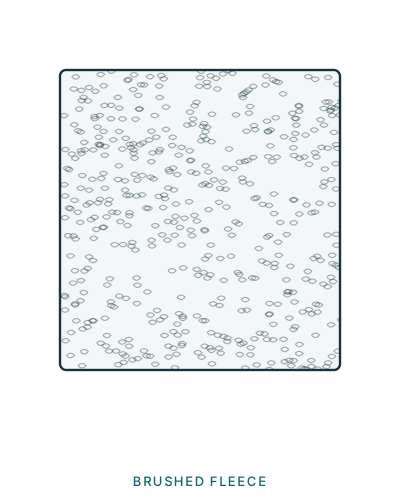
Brushed fleece structure
Brushed pile for warmth and softness.
For your sourcing brief: GSM, brushed side, anti-pill and width.
Composition CottonWeight 180-400 gsm
Full specificationstyling · fabrication · composition · weight · sustainability · performance
- Styling & fit
- Brushed fleece or polar fleece: warm, soft, high loft; for hoodies, jackets and blankets.
- Fabrication
- Fleece knit brushed on one or both sides; cotton, CVC or polyester; anti-pill finished.
- Composition
- Cotton; polyester; viscose; modal; Tencel; linen; elastane; and blends such as 60/40 cotton-polyester, 95/5 cotton-elastane.
- Weight
- 180-400 gsm; 280-350 gsm typical.
- Construction & stitching
- 3-thread fleece, brushed back; polar fleece with bonded backing option.
- Trims, branding & finish
- Lab dips and strike-offs before bulk; roll packing; fabric hand-feel, hang-test and shade-band approvals.
- Sustainability
- Options: organic (GOTS), BCI, GRS recycled, Tencel, ZDHC-aligned and OEKO-TEX-tested dyehouses, closed-loop water treatment.
- Performance
- Shrinkage, colourfastness, pilling and tensile strength to ISO or AATCC; wicking, anti-bacterial, UPF, flame-retardant or water-repellent finishes.
- Sizing, packing & MOQ
- Minimum order from 500-1,000 m per colour, 40-70 days after lab-dip approval; sample yardage on request.
- Compliance & testing
- Typical: composition and GSM, shrinkage, colourfastness (wash, rub, light, perspiration), pH, formaldehyde, azo dyes; OEKO-TEX or RSL on request.
Indicative ranges for discussion. Final composition, GSM, measurements, MOQ and tests are agreed at sampling and quotation.
Cotton twill structure
Diagonal woven structure for durable garments.
For your sourcing brief: Yarn count, GSM, finish and dye method.
Composition CottonWeight 180-320 gsm
Full specificationstyling · fabrication · composition · weight · sustainability · performance
- Styling & fit
- Cotton twill: diagonal weave, durable; for chinos, jackets and workwear.
- Fabrication
- 3/1 or 2/1 twill, combed or carded cotton; garment- or piece-dyed; peached or washed finishes.
- Composition
- Cotton; polyester; viscose; modal; Tencel; linen; elastane; and blends such as 60/40 cotton-polyester, 95/5 cotton-elastane.
- Weight
- 180-320 gsm; 220-260 gsm typical.
- Construction & stitching
- Warp-faced diagonal weave; stretch with 2% elastane optional.
- Trims, branding & finish
- Lab dips and strike-offs before bulk; roll packing; fabric hand-feel, hang-test and shade-band approvals.
- Sustainability
- Options: organic (GOTS), BCI, GRS recycled, Tencel, ZDHC-aligned and OEKO-TEX-tested dyehouses, closed-loop water treatment.
- Performance
- Shrinkage, colourfastness, pilling and tensile strength to ISO or AATCC; wicking, anti-bacterial, UPF, flame-retardant or water-repellent finishes.
- Sizing, packing & MOQ
- Minimum order from 500-1,000 m per colour, 40-70 days after lab-dip approval; sample yardage on request.
- Compliance & testing
- Typical: composition and GSM, shrinkage, colourfastness (wash, rub, light, perspiration), pH, formaldehyde, azo dyes; OEKO-TEX or RSL on request.
Indicative ranges for discussion. Final composition, GSM, measurements, MOQ and tests are agreed at sampling and quotation.
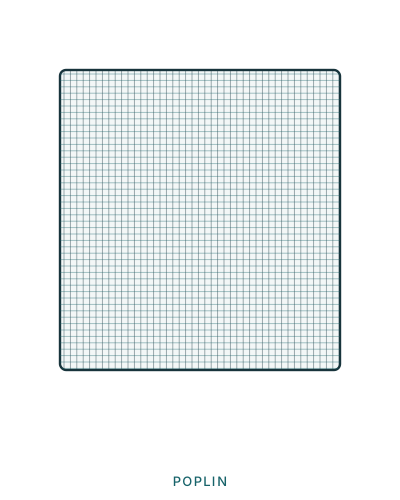
Poplin structure
Fine plain weave for shirts and dresses.
For your sourcing brief: Thread count, yarn, GSM and finish.
Composition CottonWeight 90-140 gsm
Full specificationstyling · fabrication · composition · weight · sustainability · performance
- Styling & fit
- Poplin: fine, crisp plain weave; for shirts, blouses and dresses.
- Fabrication
- Plain weave, combed cotton 40s-80s; mercerised, wrinkle-free or soft-washed.
- Composition
- Cotton; polyester; viscose; modal; Tencel; linen; elastane; and blends such as 60/40 cotton-polyester, 95/5 cotton-elastane.
- Weight
- 90-140 gsm; 110-125 gsm typical.
- Construction & stitching
- 1/1 plain weave, high thread count 100x60 to 140x90.
- Trims, branding & finish
- Lab dips and strike-offs before bulk; roll packing; fabric hand-feel, hang-test and shade-band approvals.
- Sustainability
- Options: organic (GOTS), BCI, GRS recycled, Tencel, ZDHC-aligned and OEKO-TEX-tested dyehouses, closed-loop water treatment.
- Performance
- Shrinkage, colourfastness, pilling and tensile strength to ISO or AATCC; wicking, anti-bacterial, UPF, flame-retardant or water-repellent finishes.
- Sizing, packing & MOQ
- Minimum order from 500-1,000 m per colour, 40-70 days after lab-dip approval; sample yardage on request.
- Compliance & testing
- Typical: composition and GSM, shrinkage, colourfastness (wash, rub, light, perspiration), pH, formaldehyde, azo dyes; OEKO-TEX or RSL on request.
Indicative ranges for discussion. Final composition, GSM, measurements, MOQ and tests are agreed at sampling and quotation.
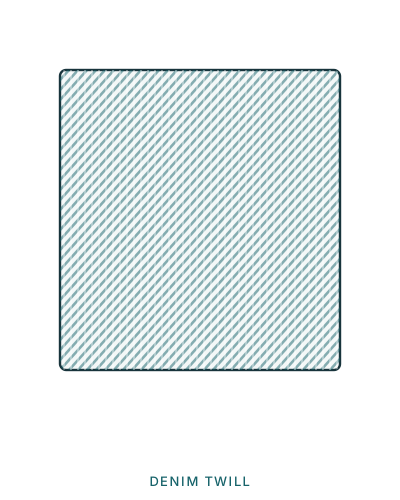
Denim twill structure
Indigo twill structure for jeans and jackets.
For your sourcing brief: Weight, stretch, wash and shrinkage.
Composition CottonWeight 8-14 oz (270-475 gsm)
Full specificationstyling · fabrication · composition · weight · sustainability · performance
- Styling & fit
- Denim twill: indigo or coloured warp, white weft; rigid or stretch; for jeans, jackets and shorts.
- Fabrication
- 3/1 right-hand twill, ring or open-end yarn; rope or sheet dyed; stretch with 1-2% elastane; enzyme or laser-washed.
- Composition
- Cotton; polyester; viscose; modal; Tencel; linen; elastane; and blends such as 60/40 cotton-polyester, 95/5 cotton-elastane.
- Weight
- 8-14 oz (270-475 gsm); 9-11 oz typical.
- Construction & stitching
- Warp-faced twill with indigo-dyed warp, sanforised for low shrinkage.
- Trims, branding & finish
- Lab dips and strike-offs before bulk; roll packing; fabric hand-feel, hang-test and shade-band approvals.
- Sustainability
- Options: organic (GOTS), BCI, GRS recycled, Tencel, ZDHC-aligned and OEKO-TEX-tested dyehouses, closed-loop water treatment.
- Performance
- Shrinkage, colourfastness, pilling and tensile strength to ISO or AATCC; wicking, anti-bacterial, UPF, flame-retardant or water-repellent finishes.
- Sizing, packing & MOQ
- Minimum order from 500-1,000 m per colour, 40-70 days after lab-dip approval; sample yardage on request.
- Compliance & testing
- Typical: composition and GSM, shrinkage, colourfastness (wash, rub, light, perspiration), pH, formaldehyde, azo dyes; OEKO-TEX or RSL on request.
Indicative ranges for discussion. Final composition, GSM, measurements, MOQ and tests are agreed at sampling and quotation.